Recommended art

New Natural History

Post image for New Natural History

November 19, 2011

Our near-downtown neighborhood buzzed all summer about the coyote. Facebook and blogs noted its daily (and nightly) moves with awe and fear. TV stations joined the chorus. It was if an alien had landed in our midst. The sightings advanced closer to our house, and one night my wife and I heard unfamiliar sounds growing louder. We realized it was the coyote yipping its way along our street, announcing its presence in the land of two-legged creatures. A few days later as I drove my son to afternoon swim lessons, the coyote padded slowly across the street a hundred feet in front of us. It appeared neither anxious or hurried.

The coyote’s demeanor left me wondering what the urban world looks like to wild animals. Are the sights and sounds and smells not only foreign but also alluring for reasons we don’t understand? Is the draw simply easier-to-find food and fewer predators or more than that? Consider what must have been coursing through the mind of another coyote discovered lounging on the train serving Portland International Airport.

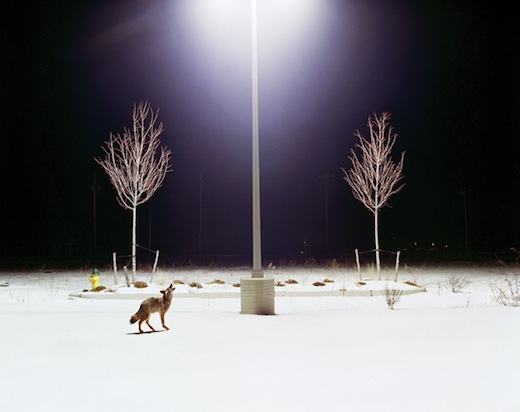
These increasingly frequent intersections of two worlds, even in metropolises such as Chicago, are explored in “Domesticated,” an evocative series of images that photographer Amy Stein calls “modern dioramas of our new natural history.”

Within these scenes I explore our paradoxical relationship with the ‘wild’ and how our conflicting impulses continue to evolve and alter the behavior of both humans and animals. We at once seek connection with the mystery and freedom of the natural world, yet we continually strive to tame the wild around us and compulsively control the wild within our own nature.”

Stein’s photo “Howl,” displayed above with her permission, echoes for me long after our neighborhood coyote has departed. The cry in the night could be a lament, a warning, a greeting. Or proud pronouncement “I am home.” The mystery is we’ll never know, and that’s the connection.

{ 0 comments }

Art on the streets

March 9, 2010

Despite Portland’s reputation for attracting artists, I’ve yet to encounter an abundance of street art depicting this level of flair and creativity. Maybe I don’t get around enough, but I mostly encounter incomprehensible graffiti. Much is gang messaging, a defacement uglier and longer lasting than cats peeing to mark their territory.

Some people are trying, judging from these photos. My own finds are here, including some on passing rail cars. An artist known as Cake, whose work has been featured in an Albany, New York gallery, apparently stopped in Portland and left behind two paintings.

I’m a big fan of my friend’s approach — temporary, portable, and free. In a story I wrote before we became friends, he said:

I’m letting go of dormant energy in my world and leaving it to other people to revive it if they want.

{ 0 comments }

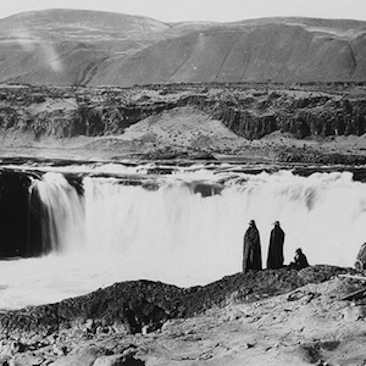
Isn’t the appeal of this photo the immediate emotional response it triggers? And that response, different for every viewer, likely has nothing to do with the moment captured or starkly beautiful landscape or its inhabitants. I guess that’s why it ranked first in this contest.

pairofhorses1

{ 0 comments }

Blood Puddle Pillow

May 7, 2009

When my wife and I were dating, I went to her apartment. She greeted me with an enigmatic smile. Smelling faintly of perfume, she led me upstairs to the bedroom. On the floor was a chalk outline, like those drawn around a dead body at a crime scene. It was me, she said.

Today I remembered that moment and the insight it gave me into her macabre sense of humor. Triggering the memory was finding “The Great Slumber a.k.a. The Blood Puddle Pillow.” Read More

{ 0 comments }

100 Meters of Existence

February 16, 2009

I can’t stop looking at photos of 178 people taken during 20 days from the same spot on a Berlin railroad bridge. The image of disconnected lives artistically stitched together into a very long, single picture is called “We’re All Gonna Die — 100 meters of existence.”

Scrolling through this gaggle of humanity is strangely mesmerizing. Few noticed the camera of Simon Høgsberg and thus are captured in mundane moments. Nothing is happening. Or so it seems until you linger on faces and imagine what the lens couldn’t see. Who are these people? What are they thinking? How did they come to be there? Where are they going?

Upon third viewing, I pictured myself in the picture.

{ 0 comments }

Lofty Views of Home

February 6, 2009

How to feel insignificant and awed at the same time: 23 stunning satellite photographs of Earth, courtesy NASA’s huge archive. Las Vegas looks more inhospitable than Antarctica. How would my city, Portland, fare from this lofty perspective?

{ 0 comments }

Obama in the Window

October 31, 2008

My artist friend Benjamin Alexander Clark churned out twenty paintings of Barack Obama in three days this week. An amazing feat by any standard, though I’m not surprised given Benjamin’s talents and energy. As of this afternoon, four had sold — the fourth to me.

The Obama paintings are prominently displayed at Cannibals on NW 21st Avenue in Portland, where owner Pamela Springfield features works by ninety-six local artists. Read More

{ 4 comments }

Art after death

August 17, 2008

Insane, abandoned, and anonymous. This describes many people who lived out there lives at the Oregon State Hospital in Salem, starting in 1883 and into the 1970s. Their cremated remains were put in numbered copper canisters and stored.

But time and chemical reactions have turned them into art after death, art challenging perceptions of what it means to die. Acclaimed photographer David Maisel has documented the stark individuality blossoming from each person’s remains.

In an essay, Maisel, who gave me permission to publish one of his pictures, writes:

The canisters ask us to consider ‘What happens to our bodies when we die; what happens to our souls?’ Matter lives on even when the body vanishes, even when it has been destroyed by an institutionalized methodology of incinerating the body to ash and categorizing it by a number stamped into the lid of the ashes’ metal housing. Does some form of spirit live on as well?

I’ll consider those questions when I see Maisel’s “Library of Dust,” his Portland Art Museum exhibit that opens September 1. My context will be the remnant of my mother’s ashes that haven’t been scattered. I’ve divided this smattering into three tiny piles, stored less evocatively than those of the insane, one each for my two brothers and me.

In life, my mother might have found Maisel’s questions too weighty. But she would have laughed at the idea of resting, at least temporarily, in my three-year-old son’s discarded plastic Play-Doh containers.

I need to find something copper that would better suit her aesthetic tastes until the time inevitably comes for her to mix with me.

{ 0 comments }

I’m hardly an art critic. And I don’t abide by the cliché, “I know good art when I see it.” Like many people, I gravitate to images that trigger an emotional and visceral reaction that lingers. That’s the experience I had last night, stumbling upon Steampunk wallpapers while cruising boingboing. Read More

{ 3 comments }

Boy and the bug

July 9, 2008

This morning at breakfast, my little boy Atticus freaked out when a big fly buzzed on a window near him. It seemed like an overreaction for someone who dug worms and fed them to the goldfish in our little pond before he could walk. (Easy for me to judge.) Maybe this stunning photo will make him less afraid. Or more:

I wish I could say I captured the image among our Portland rose bushes. Instead I’ll say “keep up the great work” to Robin Gage in Atlanta, a photographer friend of my daughter Erin. Robin proves once again that the world we typically perceive isn’t what it seems. Check out more of Robin’s rose gallery on her blog.

{ 0 comments }