Pendleton Round-Up

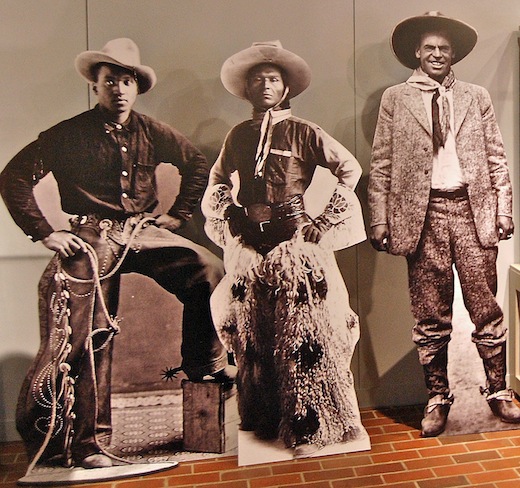
A long-dead Oregon cowboy and rodeo star, whose life I’ve written about and continue to research, is finally receiving the recognition he deserves. John Spain (right), winner of the bucking contest at the Pendleton Round-Up a century ago — an outcome still hotly debated, has been chosen for the Round-Up and Happy Canyon Hall of Fame. The honor comes decades after the two men he beat, George Fletcher (left) and Jackson Sundown (middle), were inducted into the Hall of Fame.

On Thursday I attended the Hall of Fame’s annual meeting in Pendleton, where Spain’s selection was announced. That night I had dinner with several of Spain’s relatives. They are as friendly, open, and genuine as any people I’ve met. The lively conversation made it clear that their lives are richer for having a relative whose noteworthy past brings them together and inspires sharing of stories, stories that illuminate the family’s intriguing background. And the talk wasn’t just of John Spain but his older brother Fred as well, a rodeo star in his own right and three times named “most typical cowboy” in the Round-Up’s early years. Fred also deserves entry into the Hall of Fame.

On Friday I joined three of the relatives at the Union County Museum in Union, Oregon, where the inseparable Spain brothers spent most of their lives as ranchers. Lorna Spain, whose late husband King was Fred’s son, and I delivered to the museum the life-size cutout photograph of John, pictured above. The cutout was part of the Pendleton Round-Up exhibit that I curated for the Oregon Historical Society last year, and OHS deserves thanks for giving it to the museum. (If there’s a better small-town, rural museum in America, I’ve not found it.)

As I carried “John” from my car, I couldn’t help but think he’s come home.

{ 1 comment }

Shirley Morris

As guest curator for a recently opened exhibit, “Tall in the Saddle: the Pendleton Round-Up at 100,” I worked with dozens of people across the Northwest. Sometimes the project intersected with the creative work of others. Among them was fine artist Shirley Morris of Bend, Oregon, who’s making a documentary that I’m eager to see. It’s about the cowgirls who starred in rodeos early in the last century. Not only did Shirley tailor an excerpt of her film for the exhibit, she also helped lead me to artifacts — personal items that belonged to one of the most famous cowgirls, Bertha Blancett.

The cowgirls, America’s first professional female athletes, performed around the world to huge audiences. They were tough and often glamorous. These “bucking horse suffragettes” represented new freedoms that women claimed for themselves even before winning the right to vote in 1920. Shirley’s film, Oh, You Cowgirl!, will illuminate the lives of women who in her words “left a legacy so steeped in American lore, you wonder, ‘Could it be true?’ ”

I’ll be among the first to buy the DVD. Here’s the trailer:

YouTube Preview Image

{ 0 comments }

Tall in the Saddle

March 6, 2010

Few blog posts for many months means I’ve been crushed with work. But that’s a good thing in these trying economic times. The heaviest load has come from serving as guest curator for a just-opened exhibit at the Oregon Historical Society in Portland, called “Tall in the Saddle, the Pendleton Round-Up at 100.”

In May 2009, I began tracking down artifacts and other items for the 3,000-square-foot exhibit. What I thought would be the most challenging part of the project — persuading people and organizations to loan roughly 500 things — proved to be the easiest. The most gratifying part was meeting so many people who were so eager to help. The most difficult was crafting the story for a medium that was foreign to me. Read More

{ 6 comments }

In Praise of Praise

August 6, 2009

Fame for a day, judging from this review of the book I co-authored. Observing reaction to Pendleton Round-Up at 100: Oregon’s Legendary Rodeo has been gratifying. Readers and reviewers like it so far, including on Amazon, where I’ve cajoled no one to plant praise. Granted the book’s approach doesn’t invite criticism. While not rah-rah, the tenor is certainly exuberant in its broad exploration of an event with remarkable staying power. Of course the Round-Up isn’t just a rodeo, which is key to its century of success. Few communities can boast of an annual happening so integrated into the lives of their residents from one generation to the next.

{ 0 comments }

not-jackson-sundown-houseRarely is anything as it appears. How’s that for an overused truism? But it’s one I keep learning again and again. Take the case of this abandoned house. During a seven-day research trip last week, it was first on a long list of places and people to see on the Nez Perce Reservation near Lewiston, Idaho.

Two years ago, my daughter Erin gave me a sepia-toned and more poignant version taken by a professional photographer. The gift was tied to a book that I was writing with Ann Terry Hill about Oregon’s nearly century-old rodeo, the Pendleton Round-Up, including stories about legendary Nez Perce cowboy Jackson Sundown. A caption below the photograph, which is displayed in my office bookcase, identifies the house as Sundown’s cabin. I had emailed the photographer for directions in 2007.

I finally made it there on June 20, beginning research for a much bigger story. The house, leaning south amid a hillside of flowering peas, is on Highway 95 in Culdesac. I took a dozen photos inside and out, and videotaped everything, complete with a hushed narration meant to lend solemnity to the moment. I rubbed my hand over wood weathered black. I peered at nails protruding from a wall, wondering whether Sundown used them to hang his clothes. I wanted to feel his presence eighty-six years after his death. Read More

{ 12 comments }

History Lost

March 13, 2009

Today I stood beneath a statue of Teddy Roosevelt astride a high-stepping horse. I was among  75 people in Portland’s South Park Blocks. Warmed in late afternoon sun, we protested plans to greatly reduce access to the Oregon Historical Society research library across the street.

Many people spoke of the library’s key role in their work — historians, writers, journalists, genealogists, and others. During the last two years, I spent innumerable hours there researching this book about the Pendleton Round-Up and desperately need it for my next big project. Read More

{ 1 comment }