May 15, 2011
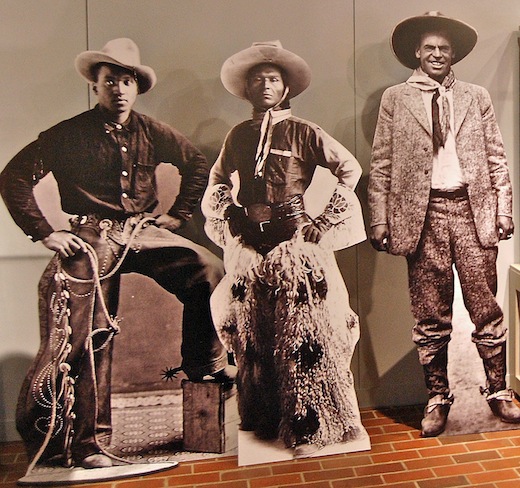
A long-dead Oregon cowboy and rodeo star, whose life I’ve written about and continue to research, is finally receiving the recognition he deserves. John Spain (right), winner of the bucking contest at the Pendleton Round-Up a century ago — an outcome still hotly debated, has been chosen for the Round-Up and Happy Canyon Hall of Fame. The honor comes decades after the two men he beat, George Fletcher (left) and Jackson Sundown (middle), were inducted into the Hall of Fame.
On Thursday I attended the Hall of Fame’s annual meeting in Pendleton, where Spain’s selection was announced. That night I had dinner with several of Spain’s relatives. They are as friendly, open, and genuine as any people I’ve met. The lively conversation made it clear that their lives are richer for having a relative whose noteworthy past brings them together and inspires sharing of stories, stories that illuminate the family’s intriguing background. And the talk wasn’t just of John Spain but his older brother Fred as well, a rodeo star in his own right and three times named “most typical cowboy” in the Round-Up’s early years. Fred also deserves entry into the Hall of Fame.
On Friday I joined three of the relatives at the Union County Museum in Union, Oregon, where the inseparable Spain brothers spent most of their lives as ranchers. Lorna Spain, whose late husband King was Fred’s son, and I delivered to the museum the life-size cutout photograph of John, pictured above. The cutout was part of the Pendleton Round-Up exhibit that I curated for the Oregon Historical Society last year, and OHS deserves thanks for giving it to the museum. (If there’s a better small-town, rural museum in America, I’ve not found it.)
As I carried “John” from my car, I couldn’t help but think he’s come home.

We try not to over-indulge our five-year-old son. Still, Atticus has ended up with many more things than any kid can keep track of, much less play with. I could haul away all his toys, and he wouldn’t complain — as long as he was lording over this small creek winding its way to the Pacific Ocean. Each day of our Oregon coast vacation last week, the creek was the center of his universe. At night he wondered whether the dam he built was still there. He wanted to know where the water comes from and ends up. (China seemed an acceptable answer.) He wanted to put a note in a bottle and send it seaward.
Now, back in the humdrum of our routine existence, I could offer to buy him any of the 1,361,605 toys sold on Amazon.com. No doubt he would prefer instead the sand, flowing water, rocks, and freedom to shape them as he wishes. Or do they shape him?
As guest curator for a recently opened exhibit, “Tall in the Saddle: the Pendleton Round-Up at 100,” I worked with dozens of people across the Northwest. Sometimes the project intersected with the creative work of others. Among them was fine artist Shirley Morris of Bend, Oregon, who’s making a documentary that I’m eager to see. It’s about the cowgirls who starred in rodeos early in the last century. Not only did Shirley tailor an excerpt of her film for the exhibit, she also helped lead me to artifacts — personal items that belonged to one of the most famous cowgirls, Bertha Blancett.
The cowgirls, America’s first professional female athletes, performed around the world to huge audiences. They were tough and often glamorous. These “bucking horse suffragettes” represented new freedoms that women claimed for themselves even before winning the right to vote in 1920. Shirley’s film, Oh, You Cowgirl!, will illuminate the lives of women who in her words “left a legacy so steeped in American lore, you wonder, ‘Could it be true?’ ”
I’ll be among the first to buy the DVD. Here’s the trailer:

This time-lapsed video perfectly punctuates a morning of snowshoeing with my wife, along the glacier-fed White River on Mount Hood. Shot 2,600 miles away on Mauna Kea, Hawai’i, the video reminds me of my insignificance in the universe and, at the same time, the wonder of being part of its grandeur. The photographer had this composer’s music in mind when he created the video. The soundtrack of our mountain trek? Crunching snow, water against rock, and panting breaths.
I’ve been thinking of “The Big One.” Long before earthquakes devastated Haiti and then Chile, I wanted to have our 1920s Craftsman house bolted to its foundation with steel plates. That’s enough protection to qualify for earthquake insurance.
The work begins tomorrow, ten months after I arranged for an estimate. Waiting until my wife and I could afford the work was a gamble, considering that scientists believe an earthquake of up to 9.0 magnitude off the Oregon Coast is inevitable within the next 50 years.
The last such quake in the Cascadia Fault, 310 years ago when the indigenous people sparsely populated the region, triggered widespread devastation. There are also three faults beneath Portland — one only a few blocks from our house — capable of delivering quakes of 6.5 magnitude or greater. Talk about Ground Zero. Read More
Until the last few days, I hadn’t traveled through the Columbia River Gorge and seen the new price of protecting the planet. For several miles east of The Dalles, the bare ridge lines that for eons had starkly demarcated earth from sky now are scarred with wind turbines. Aligned like robotic sentries, they look like a science fiction future set in the prehistoric past. Read More
South of the tiny hamlet of Pilot Rock along a lonely road, I saw an ancient barn. One end had collapsed. No one lives close enough in the desolate hills to have heard it. The rest of the building looked ready to fall in the next big wind. I ventured inside. Sunlight poured through holes in the roof. Dried cow dung littered the dirt floor. From a darkened corner came a noise. A deer stared at me then scrambled through a gap in the rear wall, hooves clattering on fallen planks. I was alone.

Posting a comment on Facebook has landed me a radio show interview tomorrow. Topic: the implications of severe cutbacks at the Oregon Historical Society Research Library, where I spent much of the last two years researching this book. Read More
Feel like the country is overrun with greed and inefficiency? Hard not to these days. So these numbers sprang off a whiteboard at the Oregon Humane Society today:
Animals adopted last year: 3,810 dogs, 5,197 cats, and 999 other (rabbits, hamsters, and similar small animals).
Adoption rates, respectively: 99, 95, and 92 percent. Only medical and behavioral issues prevented a 100 percent score.
Maybe the Humane Society should run Wall Street.
I worked on a book about a world-famous rodeo for 18 months with another writer, Ann Terry Hill. I also did extensive digging for old photographs. Recreating events from decades ago based on historical research was exhilarating. Nothing motivates me like the thrill of the hunt for hard-to-unearth information.
At the outset, most of what I knew about rodeos I learned from TV as a kid. The deeper into the project I went, the more I was moved by the triumphs and travails of cowboys, cowgirls, and Indians — notably those in the early part of the last century. Read More
What Google search term do Oregon residents use more often than people in other states? That’s what I wondered as I tried out a search application that ranks popularity of queries by state.
Rainfall immediately came to mind, but Oregon ranks third behind Hawaii and New Mexico. Bicycles is a sure winner, I thought. Nope, second behind Colorado. Sustainability? Second to Vermont.
No way any other state’s residents are more interested in all things organic. Damn that Vermont! Oregon finishes second again. Same goes for marijuana. Vermont also finishes atop all states for peace, climate change, hippies, granola, recycle, and farm. You get the picture. Read More
I have this thing for gardening. Just me and plants and dirt. Creative yet mindless. Mixing and matching. Trial and error. Nobody telling me how to do it.
My three-year-old son draws better than me, but the yard is a canvas on which I can paint something of merit. I say “I” as if it’s me making the art. But in this part of Oregon, any fool can fashion a wonderland of color and texture and symmetry. The climate in Portland, viewed as inhospitable by some, is ideal for growing things. Read More
Driving east from Portland on Interstate 84 is humbling. I’m but an insignificant speck squeezing between the Columbia River’s slow-flowing expanse on one side and cliffs on the other.
As I cross the Cascade Mountains and encroach upon the high desert at The Dalles, a question arises: is there anywhere else in the United States where the geography changes so radically in so short a distance?
The transition from lush green to withered brown and black is like entering an alien world. The basalt rock escarpments and deeply furrowed hills look impenetrable. One doesn’t pass through but over them, as if traversing a two-dimensional painted movie set.
The panorama is too grand, too sweeping to let a Florida flat-lander like me truly enter. (I venture that most true-blood Oregonians feel the same way.)
Even when I stop and feel the ground crunch beneath my feet, dip my hands in the cold river as I did today, it doesn’t feel as if I belong.