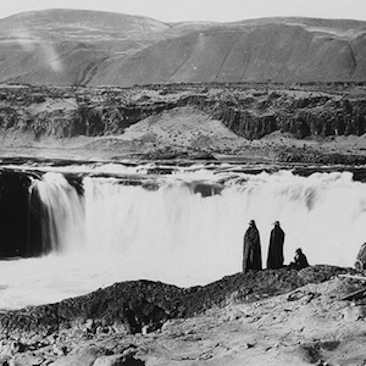
[youtube]http://www.youtube.com/watch?v=9TfdA9fWb_g&feature=related[/youtube] “I am not a number, I am a free man!” That memorable line by actor Patrick McGoohan is from the 1960s TV series The Prisoner, which riveted me years later. I remembered the line today when learning that I have a number. There’s nothing official or sinister about my number, 2,772,772,874, unlike that of […]
Read the rest...

October 15, 2011
Blind trust or death wish? One or the other afflicts the many pedestrians using cell phones as they cross busy downtown streets. I see them often while driving in downtown Portland. They don’t see me. The increased risk of getting run over while using phones is well-documented. Now comes Siri, the virtual personal assistant on […]
Read the rest...
Imagery that sticks with me often involves water. It’s also spare, several words that echo back in pictures of resounding clarity. For many months two images have replayed randomly, one from a song lyric, the other from a conversation. The Portland-based band Casey Neill and the Norway Rats sings: 2 a.m., swimming in the quarry, […]
Read the rest...
A few years ago I wrote here about a work colleague who disclosed that he had a chimpanzee. I remembered his disclosure while reading about a chimp ripping off a Connecticut woman’s hands and much of her face. Now comes news that the woman has undergone a successful face transplant, the tenth such surgery in […]
Read the rest...
April 17, 2011
Like one of my favorite bloggers, Jason Kottke, I was put off by the idea of parties for parents to learn the sex of their gestating child. Then a video he linked to choked me up. Guess I’m a sucker for such joy. Still, not knowing the sex adds to the mystery and suspense of […]
Read the rest...
April 10, 2011
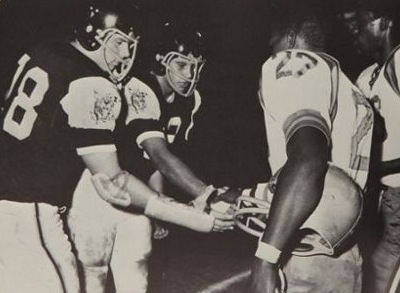
The serendipity of discovery on the web is old news, though it remains a hallmark. I was reminded of this recently when, as a longtime subscriber to Classmates.com, I received an email about the site getting a new look and name, Memory Lane. I clicked the link and immediately saw links to yearbooks from my […]
Read the rest...
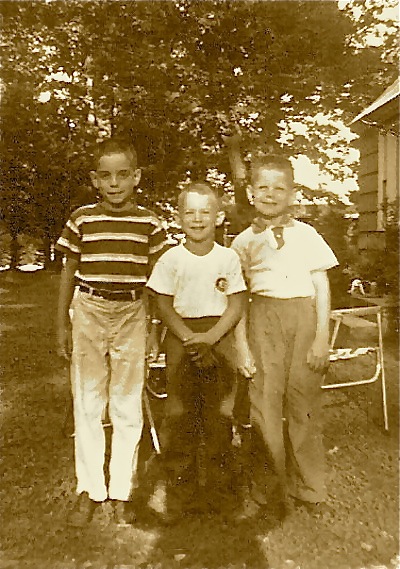
Some photos haunt me. None more than this one. It was taken behind our house in Nashua, New Hampshire, circa August 1958, seven months before our family moved to Florida. My two brothers and I posed for our mother, and judging from our expressions, we hadn’t yet reached the stage of reflexive smart-ass resistance to […]
Read the rest...
September 15, 2010
Nearly a decade ago, a sudden medical problem made me afraid I was going to die on the spot. What had I done to deserve the infamy of croaking in Costco?
Read the rest...
Today is World Water Day, an event intended to draw attention to serious problems but for me evokes nostalgia. That’s what happens when a childhood is spent immersed in a Central Florida lake back when the water was clear and clean. Some days my brothers and I would swim so long that I imagined gills […]
Read the rest...
In the 1980s, I tacked up a poster in my newspaper office. It promoted an exhibit at the Smithsonian: “Yesterday’s Tomorrow’s: Past Visions of the American Future,” which I never saw. The poster gripped me in ways I didn’t understand. Maybe it was the fanciful and futuristic scene from a world that never came to […]
Read the rest...
Few blog posts for many months means I’ve been crushed with work. But that’s a good thing in these trying economic times. The heaviest load has come from serving as guest curator for a just-opened exhibit at the Oregon Historical Society in Portland, called “Tall in the Saddle, the Pendleton Round-Up at 100.” In May […]
Read the rest...
News that Farrah Fawcett died this week at age sixty-two conjured a memory. I was a young reporter in Thomasville, Georgia. It was 1975 or thereabouts. I wrote a story about a boy afflicted with a terminal disease, a boy whose only source of joy was his obsession with Charlie’s Angels.
Read the rest...
In 1978, when I was a young newspaper reporter in Melbourne, Florida, I covered a protest march by a few dozen Iranian students. Carrying placards and shouting slogans, faces flush with anger, they looked as if they had wandered onto the wrong movie set. I didn’t know much about the target of their rage: the […]
Read the rest...